
Geoffrey B. Small — Artisan
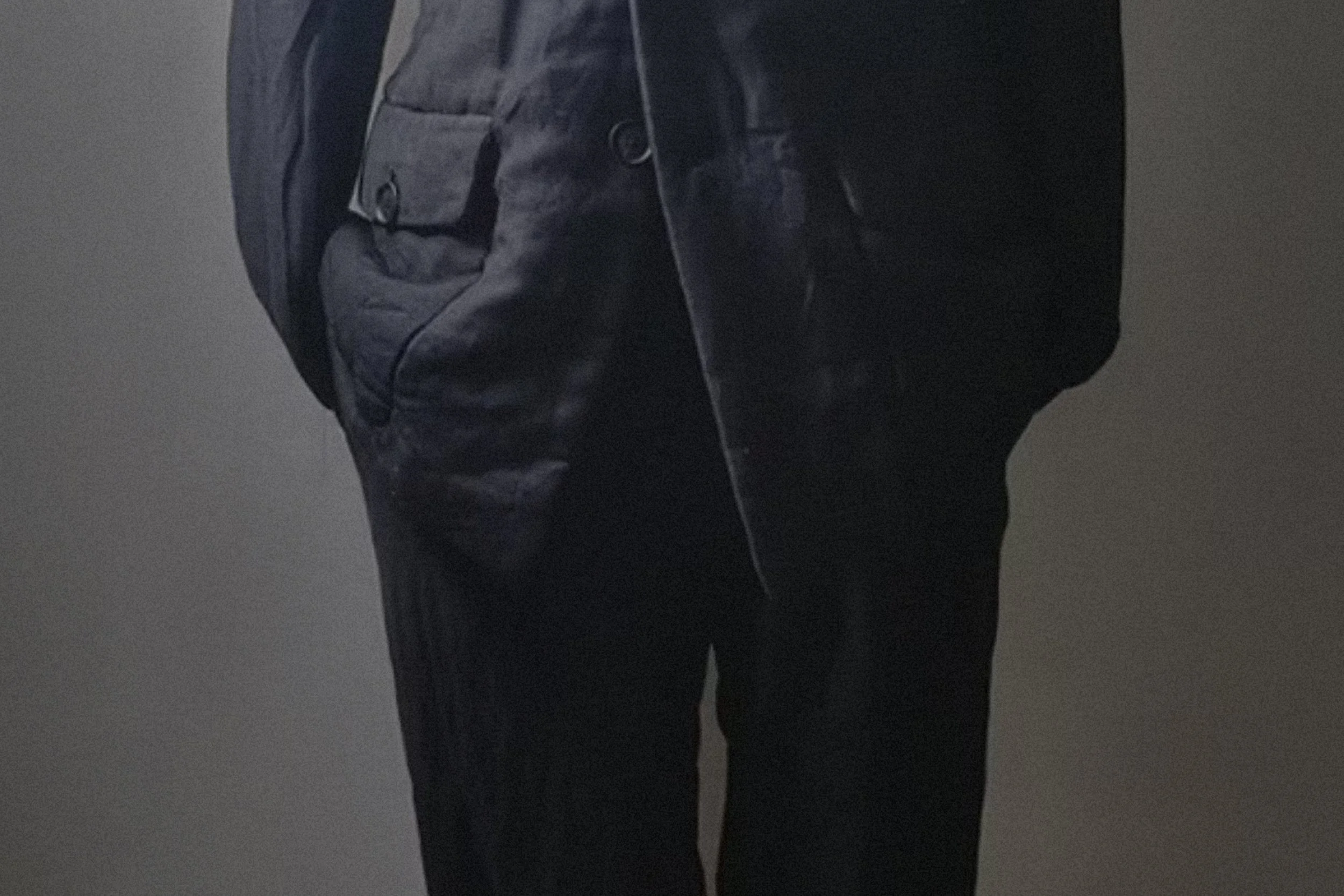
As a designer of clothing and what we call fashion, we must readapt our approach entirely to a world spiraling into chaos by a system of human civilization and philosophies that is not working — and whether humanity likes it or not — is changing rapidly. After more than 36 years in the field, and more than 22 years at the Paris designer collections level, no period in my career has been more challenging and more important than this one. While our impact may be limited to a small circle, the circle is a powerful one, and one that can have great influence on consumer and industrial behavior at wider levels over time. So, we must ask ourselves „what can we do?” And as our specialty and focus has been always at the forefront of the avant-garde we must also look and try to predict where things are going. Our goal in these difficult times as an independent designer, continues to be to survive and maintain our name and work by developing and introducing exclusive new solutions in design, manufacture and services that others in the industry will try to copy and follow.
Our impact over the years has not been insignificant, and as a result, an awful lot of designers and brands are now claiming to make „handmade” or „artisan” or „sustainable” or „ethically produced” clothes these days. But in fact, very few really are. And while so many are simply just trying to jump on another band-wagon or suddenly sellable „trend” in the industry, our goal is to totally redefine the role of real tailoring in modern clothing at the designer level. We believe the new crises in the global economy and environment are symptoms of an industrial system that no longer cares about customers, or human talent and skill, or people in general. We believe that now is a great time to return to the age old art of making clothes for people one at a time. To rehumanizing the clothing experience to the value where it properly belongs in an honorable, stable and civil society. We believe in offering the customer a new level of service, long term value, and satisfaction.
Reducing the amount and quantities of product and making things that last as long as possible is a tantamount to the new wardrobe philosophy. It takes a tremendous amount of skill, time and work to make a Geoffrey B. Small limited edition article, and it is financially and logistically impossible to over-distribute and over-produce. Every piece must count for maker and wearer. If making clothing is going to cost more in the future — and it will — especially in regards to environmental, resource and human costs, it must contain less waste, and that includes pieces that are over-produced on speculation using slave labor tactics, massive amounts of water, energy, petrochemicals, plastics, natural resources and alarmingly huge amounts of global warming gas emissions. The arguments against large mass-production clothing and textile products at any retail price and their true costs to the consumer and our very civilization today as it stands have been well documented now by many others as well as this writer. And the solution is undeniably clear, micro-scale design and production specifically targeted to individual niche customers in exclusive and limited series is the logical sustainable and humane approach. After almost forty years of practice, we are now today the world leader in carrying out this approach each and every day for a growing market of customers who understand that decisions regarding where they put their money into, for their wardrobe needs carries a responsibility not only for themselves, but for their family and dear ones, their society and the future of our civilization on earth as well.
From the signing of the pieces, to the type of retailer you will find our work in, to the extreme hand making and creation technologies we use day and night to build the most labor and time-intensive designer clothes collection on the market today, everything we do is based upon bringing the value of the intelligent human being back into the clothing experience in very a big and bold way. Our mission is nothing less than to reteach the world how to make clothes in the 21st century. It is a reconfirmation (that adds significant time and risk to the production and delivery of each piece), that contrary to the rest of the industry’s out-of-touch business-school thinking, we do not believe in scaling up. On the contrary, we believe in scaling down.
Our entire world clothing production in 2015 was limited to just 1.726 pieces. That might help explain why we don’t make a big deal about trying to chase down a lot of press or media coverage, or try to be available in more and more stores around the world. or lots of other things designers and brands may do to try to „raise their profile”. We just don’t care, believing instead that our clothes speak for themselves. The new economic realities of today demand that rich or poor, every penny counts. With customers now realizing that low-prices are no guarantee of saving money in the long run, the adage of „you get what you pay for” is ringing more true than ever. Designers working and still producing in western industrialized countries must now really deliver the very best money can buy.
Since 1979, I have dedicated my working life to raising the Art and Science of making clothes by hand. To continue on that mission, 16 years ago I came to Italy for one reason: to make the world’s best clothes humanly possible for the age in which we live in now.
The rising costs of global transport and the massive greenhouse gas emissions caused by it has created a new reason for work to travel less and less. Therefore, the sourcing and assemblies of product need to be performed as locally as possible. In this remarkable country where a small, daring, and increasingly elite part of its current living generation is now fighting for its very life to save the legacy of artistic and cultural know-how that has been passed down for millennia in this land, we have developed a unique network of the world’s most advanced industrial and artisanal suppliers for fabrics, components, accessories, threads and treatments. Across the entire spectrum of suppliers we have the world’s very best technical, cultural, and artistic working masters all within a maximum radius of just 250 kilometers.
For the past 10 years, we have been steadily increasing the amounts of handwork involved in the creation of our pieces, and we can now state that the handmade component of our work is the highest in the designer industry bar none. Our focus has not been just to reproduce effects of „a day gone by”, but to look at, and arrive at, new and forward-looking applications of hand-work on modern 21st century life and design as we know it. We redefine handwork now not as simply craft or artisanship re-enactments, but a true human-based form of technology and Art.
Hand work requires no electricity, petroleum or machinery. It emits no carbon or methane into the atmosphere. It provides life skills and work to human beings and enables them to create garments autonomously with less dependency on a system with vastly diminishing resources (for example, one of us can execute a beautiful hand slip-stitch down a jacket front ourselves with just a needle, thread and know-how, far faster, less expensively, and more beautifully than the classic AMF machine system industrial alternative). And it creates high value works that are beautiful, unique and meaningful in a multitude of ways. The return to handwork is also leading us to a new world of artistic perspectives and directions that we are continuously pursuing and experiencing as we increase this new interpretation to maximize a very old application.
We have learned that the hand work concept is not at all limited to the cutting, sewing and assembly of our ideas. During my time in Italy, I have had a marvelous chance to study and develop a wide and growing array of ways to treat and alter fabrics and materials and add new layers of dimensions to our design concepts, starting with established masters working in Italy, and then on my own in our studios at Cavarzere. Some of the most exciting and beautiful results have come from years of hand-dyeing our clothes in a long list of organic dyes and substances that each yield special results. Like hand clothes-making, hand dyeing with organic materials is a very sustainable technology that can use far less carbon-generated energy than traditional industrial procedures and allows us to rediscover and re-examine an Art form that spans our entire human history on this earth.
And now more than ever, as we urgently seek balance and sustainability at the climax of the industrial age, a knowledge of history and how our ancestors lived and managed their environment and resources is invaluable. For 10.000 years humans made DO without electricity, gas, nuclear power, petroleum, airplanes, automobiles and the myriad of electric appliances and gadgets that we now cannot seem to live without. Perhaps because I am a history and culture-starved American living in Italy, now with seemingly unending discovery of how people lived on this continent that is still recorded and available (unlike at home where the culture of our native population was wiped out in the 19th century), I am constantly amazed and reminded of the blip in time that our „way of life” represents in the general scheme of things. And I am constantly amazed at how many simple, elegant and efficient solutions, as well as mistakes and warnings of how not to handle our current problems, lie in studying and looking at how people lived before us. As Pablo Picasso once stated, „an artist is only as good as what he knows”, and what he knows is totally dependent on the culture in which he is living. And a culture is only as good as how well the current generation of its people know the history of how their ancestors lived, survived and prospered on the very same ground where they try to stand today. As the saying goes, „those who do not know history are destined to repeat it”, and that holds particularly true for civilizations in decay and decline. And in our Art, we must reflect not only what is happening in the world around us, but also what has happened before us. Then knowing what is going to happen next becomes almost obvious, if not crystal clear. doing something to make things better becomes a possibility as we seek to uphold the creative duties and research and developmental responsibilities of constantly redefining what it means to be „avant-garde”. And to look ahead these days at the world around us takes great courage and honesty, as the picture is not all pretty to look at.
For example, a recent report from the Bank of England’s chief economist predicts that up to 80 million people in the United States, and 15 million in the United Kingdom will lose their jobs to automation. Other countries everywhere are expected to similarly be affected and hundreds of millions will be affected economically. What will they do? Similarly, scientist Mark Browne’s stunning research on ocean water plastification indicates that the textile industry and its explosive use of polyester and petrochemical fibers is at the heart of an unprecedented new level of contamination of the world’s water and oceans. These are just two of the latest pieces of news that form a puzzle and a story of a ruling class that is blatantly allowing, and indeed, leading our entire civilization towards collapse and self-destruction. In fact, the solution to some of these players is to allow chaos, environmental catastrophe, and ever expanding militarized conflict to take over and as it does, to profit handsomely from it all and reduce the world’s problem of over-population dramatically at the same time. I know this may not interest most readers of a design or art or fashion publication, but this is the reality for those who are paying attention.
Eliminating jobs, reducing labor-costs, eliminating skills and education and training, and focusing on maximizing short-term profitability is the objective of almost every major corporation, government entity and business from small to medium size in the world today — including fashion, clothing and design firms. But where does this approach lead us in the end? Like austerity and trickle-down economics, it leads to a complete dead-end and shut down of the economy and tremendous suffering among vast numbers of a population. In between, it provides increasingly poorer products, service, and quality of life to both the customer and the worker. And we believe it is the wrong way to manage and build a company today in the 21st century that intends to grow and survive. Contrary to many heads of corporations, governments and organizations, we believe the future is in labor-intensive applications on a mass global scale utilized and practiced at the local level allowing communities to once again become self-reliant and self-sufficient. We believe in hiring people, investing in their education and skills, paying them more and in return building a higher value, longer lasting, better performing, more sustainable and environmentally non-damaging product and service that will enhance and enrich our customers lives better than the competition. we are racing to achieve that goal and show that there is a better way to do things and run things in this world.
Our view of artisanship is not just about the small operation and the mastery of the craft, but also about the possibility that larger organization(s) may also someday be able to redefine itself successfully by implementing and maintaining the fundamental principles which we follow in our work every day. respect for the individual, service to others, strive for excellence, strive to have fun, loyalty and trust.
We do not want to be the biggest, just the best at what we do. But we believe our approach may be able to positively impact more people in more ways than are currently imagined. And as we are now uniquely positioned and building ourselves into one of the great sartorial tailoring and design houses in the history of our Art, finding, teaching and developing a new generation of master tailors and designers is paramount to achieving that possibility. In the end, we believe in the human being. I cannot do what you do. You cannot do what I do. But together, we can do something beautiful. Maybe even change the world. That is what we think about with each and every piece of our work that we create. And what comes to mind if you wish to talk about artisan values, issues and such.
Words by
Geoffrey B. Small
Image courtesy of
Geoffrey B. Small